Blog post 7: Art as a means of alleviating social Exclusion. Is it worth the investment?
The Eleonora Belfiore (2002) reading, undertaken this week, addresses a number of important points regarding the implementation of cultural policies aimed at diminishing social exclusion by the DCMS. The article explores whether the allocation of resources to artistic practices aimed to reduce the percentage of social exclusion is in fact beneficial to society. Belfiore (2002) contests whether Art is capable of alleviating social exclusion in the first place, and how (if at all) this can be measured. She highlights that thus far there has not been substantial research undertaken to prove the positive correlation between funding artistic practices and the diminishment of social exclusion, therefore questioning whether the funding of these practices is sustainable at all.
The following blog entry shall address Belfiore’s concerns
and propose the funding of artistic practices in the UK, and the EU, as
sustainable regardless of whether we can scientifically draw a link between art
and the diminishment of social exclusion. The blog entry illustrates the
positive impact of creativity on the general well being of human individuals as
well as societies as a whole which artistic practice promotes (Rose and Lonsdale, 2016).
This hypothesis is then applied to/proven by the example of the Slovenian Third
Age University, an institute funded by the Slovenian government which strives
for sustaining the human cognitive function and social inclusion amongst the
retired (UTŽO, 2018).
To contest Belfiore’s questioning tone with regards to art
as a means of promoting social inclusion I thus present Rose and Lonsdale’s
(2016) article Painting place: Re-imagining landscapes for older people's
subjective wellbeing. Rose and Lonsdale (2016) highlight the elderly population
as one often subject to social exclusion resulting from the ‘progressive
disengagement from social spaces used by younger age groups’ (Rose and
Lonsdale, 2016). They characterise the ageing population as ‘prisoners of
space’ (2016) which leads to increased exclusion from the rest of society and
in turn yields a deterioration of their wellbeing. In turn, this makes the
ageing population the ideal demographic of study when discussing the positive impact
of art on human wellbeing.
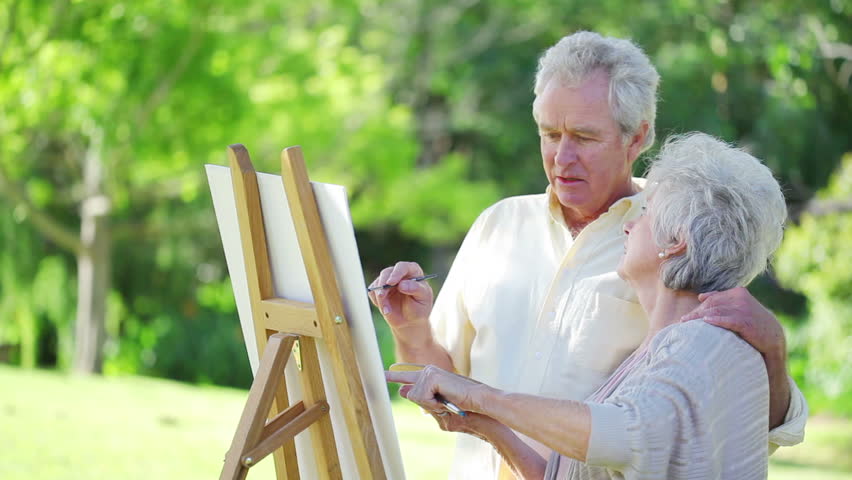
Rose and Lonsdale (2016) conducted a study where they
addressed the impacts of active engagement with artistic practice on public
mental health and wellbeing, more specifically that of painting a landscape.
They conducted the study on a group of 23 people, aged between 65 and 86 years
of age, who were given the task of creating a painting of a landscape that
resonated with them. Through collecting qualitative data of the impacts of such
active engagement, by means of in-depth interviews, discussion groups and
questionnaires, Rose and Lonsdale (2016) found that engaging with artistic
practice does indeed yield positive results in terms of wellbeing. Their study
found that the individuals’ sense of self value increased as a result of
undertaking a new challenge, successfully completing the task at hand, and
through the validation in taking part in discussion following the completion of
their task. The participants reported feelings of safety stemming from the
collective undertaking of a given activity and through the sharing of purpose
between like-minded individuals. Furthermore, the participants reported feeling
in touch with their own identity as a result of depicting a landscape that was
meaningful/close to them. Lastly, Rose and Lonsdale (2016) also report the
surprising discovery of the long term positive social effects which the
activity had on the participants. The activity provided an opportunity to
connect with other individuals which the participants have not met before and
‘increased opportunities to talk to others.’ which the participants reported as
beneficial and valuable (Rose and Lonsdale, 2016).
Lastly, to illustrate a personal engagement with the
material studied at hand I shall conclude with the example of The Slovenian
Third Age University. As aforementioned, the Third Age University is an
institution in Slovenia which aims to sustain the cognitive and social
abilities of the elderly population. The school offers a collection of classes
ranging from more artistic ones, such as pot making, calligraphy and drawing
classes, to more theoretical/cognitive ones such as the study of the
architecture in Ljubljana or that of learning a new language. The school
epitomises the benefits of governmental investment into artistic practices to
promote social inclusion as its participants reciprocate feelings of inclusion
through an improved social life. My grandma is a prime example of the success
of such a program. She has taken part in a range of classes offered by the school
and wholly stands behind its cause. In accompanying her to the annual signing
up for classes, I can vouch for positive impact which the school has had on her
life. As we walked into the building, little did we reach the room where the
sign up sheets were held and yet had to stop a minimum of three times on the
way in order to greet people which she knew. Furthermore, my grandma reports
the vast range of social connection which the school has enabled her to make,
all of which she maintain outside of class through group meetings, or
activities such as going for coffee or lunch. In addition, she takes pride in
the works created during class as well as for the activities which she must
undertake in preparation for the classes themselves. She often vouches for the
skills and knowledge which the school has brought her and takes pride in being
able to sustain her cognitive functions through gaining knowledge in areas not
previously explored in her life. Her affinity and dedication to the school
serves as the perfect example for which the government funding in the arts as a
means for promoting social inclusion is a sustainable and, more importantly, a
beneficial one.
_________________________________________________________________________________
Bibliography
_________________________________________________________________________________
Bibliography
- Eleonora Belfiore (2002) Art as a means of alleviating social exclusion: Does it really work? A critique of instrumental cultural policies and social impact studies in the UK, International Journal of Cultural Policy, 8:1, 91-106.
- Rose, E., Lonsdale, S. (2016) Painting place: Re-imagining landscapes for older people's subjective wellbeing. Lancaster: Lancaster Institute for Contemporary Arts, Lancaster University.
- Slovenska univerza za tretje življenjsko obdobje. (2018). O nas - Slovenska univerza za tretje življenjsko obdobje. [online] Available at: http://www.utzo.si/o-nas/ [Accessed 11 Nov. 2018].


Comments
Post a Comment